
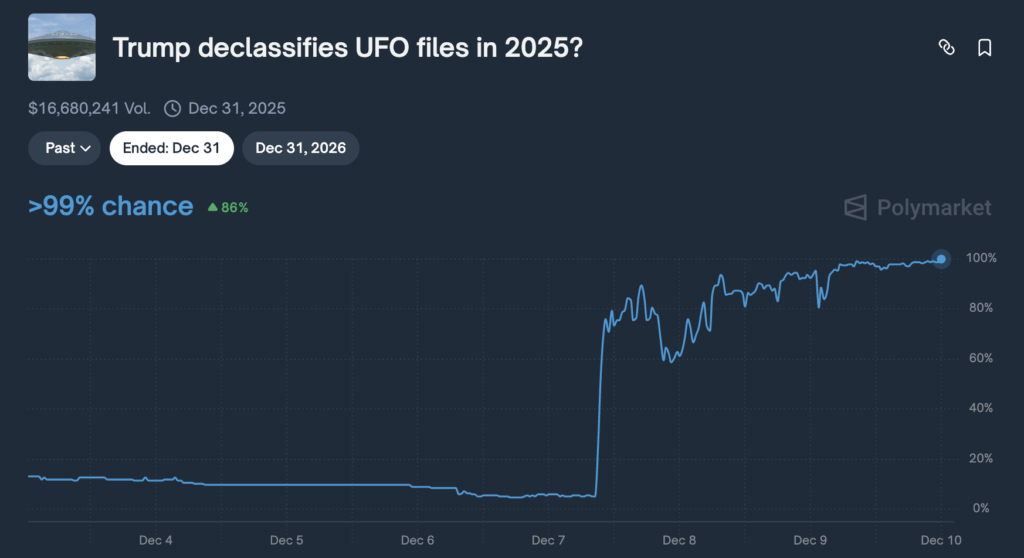
Polymarket just resolved “YES” on a $16 million market asking whether the Trump administration would declassify UFO files in 2025… even though no documents have been released.
The outcome arrived after late-session buying near 99 to 99.9 cents, and a resolution through UMA’s Optimistic Oracle, which recorded multiple disputes before finalization.
The oracle pipeline relies on a two-hour challenge window followed by a tokenholder vote with a commit-and-reveal period that typically spans about two days, with proposer and disputer bonds commonly near $750.
Votes are token-weighted, and misbehaving voters can be slashed, which concentrates decision-making power among the traders who supplied liquidity.
This structure explains why whales might rationally pay near par if they believe settlement is imminent or undisputed, even in the absence of public notice.
Primary public sources post no contemporaneous federal declassification notice. The National Archives’ UAP resources hub lists research collections and background guidance, but does not include a December 2025 declassification bulletin.
According to the Pentagon’s AARO “Official UAP Imagery” site, new items were added on Dec. 9, 2025, as part of the Department of Defense publication flow, not as a result of a White House declassification order.
The gap between a “YES” resolution and the absence of a new public declassification artifact centers the story on oracle mechanics and market structure rather than fresh disclosures.
Community reaction calls Polymarket a “scam”
Polymarket comment threads turned sharply critical after the “YES” call. Many posts labeled the outcome a “scam” and mocked a “proof-of-whales” or “proof-of-stake” model tied to UMA token voting.
Users alleged that whales bought near-par into finalization and said token-weighted governance overrode trader consensus. Several urged filing support tickets or even hiring lawyers to contest the decision.
Some distinguished between price moves and process. One theme was that price manipulation is “part of the game,” but “manipulating results” through governance is unacceptable, reflecting distrust in the dispute process rather than trading dynamics alone.
Confusion spilled into related markets. Commenters asked why a “before 2026” market could resolve while a “before 2027” market had not, arguing that similar facts should apply. Others pointed to the rule text that announcements not implemented within a market’s timeframe do not count.
Participants repeatedly asked when any new “evidence” would appear publicly and noted the lack of a contemporaneous U.S. government press release. For critics, that absence undermined credibility, even if the oracle followed documented procedures.
A minority of replies defended quick settlement or urged others to “appreciate” Polymarket’s speed, but neither group provided new sources.
Market structure signals behind the dispute
Publicly shared market metadata points to a request that began in April and closed just after midnight UTC on Dec. 10, following two disputes that escalated into UMA governance.
That sequencing, paired with the late near-par bids, fits a process-edge thesis.
If a proposer stakes “YES” and no one meets the bond within the challenge window, the proposal passes by default and settles. If disputed, tokenholder voting decides, not trader balances. Where rules hinge on intersubjective readings, oracle voters can deem technical satisfaction based on archival movements or agency posts that have not yet propagated through mainstream press.
A concise snapshot of the market timeline and the volume backdrop helps frame the integrity question within the current prediction-market cycle:
| Item | Detail | Source |
|---|---|---|
| Market creation | Apr. 17, 2025 (UTC) | Polymarket market metadata |
| Resolution path | Two proposals, two disputes, UMA finalization | Polymarket Documentation |
| Finalization time | Dec. 10, 2025 00:27:58 UTC | Polymarket market metadata |
| Bond economics | Typical proposer/disputer bonds ≈ $750 | Polymarket Documentation |
The economic logic behind late near-par buys is straightforward. Buying 0.998 to receive 1.00 on settlement yields 0.2%, which on a $615,000 order returns roughly $1,230 before fees. One trader made this exact trade around 10 hours before the resolution.
That trade makes sense if settlement risk is near zero and timing is near term, or if platform incentives offset the capital cost. According to Polymarket’s holding rewards explainer, some markets carry yield mechanics that can interact with position sizing and holding time, though a one-hour window largely neutralizes that effect.
The current episode slots into a line of governance flare-ups
According to WIRED, UMA token votes over a Zelensky clothing market and a Ukraine mineral-deal market drew community pushback, and even Polymarket characterized one call as wrong.
A Yahoo Finance overview of arb activity across 2024 and 2025 describes tens of millions of dollars captured by bot-like strategies exploiting mispricings and structural edges, a reminder that profits often flow to speed, rule mastery, and efficient capital rather than novel information.
Macro forces amplify the stakes. November delivered record combined volumes near $9.5–$10 billion across Kalshi and Polymarket, according to The Block data, while mainstream distribution is widening.
CNBC will integrate Kalshi prediction data across TV and digital in 2026, which moves these odds into broadcast quote stacks where data quality and settlement audibility matter.
At the same time, state regulators are testing boundaries. Connecticut’s Department of Consumer Protection issued cease-and-desist notices to prediction platforms operating in the state, and the Massachusetts Attorney General moved to block Kalshi sports contracts in court.
These actions give integrity disputes a consumer-protection frame that can extend beyond reputation and into legal risk.
How prediction markets can harden contract design
Against that backdrop, the UFO market’s “YES” highlights design choices that can be adjusted without halting activity. Longer challenge windows on subjective government-action contracts would reduce time asymmetry.
Higher proposer bonds would raise the cost of low-quality proposals. Explicit source lists, such as White House executive actions pages, National Archives bulletins, or Defense Department releases, would constrain interpretation and set clear evidence thresholds.
Alternative oracle designs that route votes to a broader or stake-weighted set of participants could better align outcomes with trader consensus. However, they introduce separate governance risks that need disclosure.
A separate thread is how rumor propagation interacts with markets. The SEC’s account compromise on X in early 2024 briefly moved Bitcoin ETF odds before the real approval arrived, an illustration of platform-mediated information jolts moving prices ahead of authoritative documents.
When a market’s rules key on “credible reporting,” cycles like that can create whipsaws. For government-action contracts, codifying primary sources reduces this gap.
Rumors, Oracles, and the Price of “Credible” Signals
According to the National Archives UAP page, the hub aggregates existing materials and was last updated earlier in 2025, and according to the AARO “Official UAP Imagery” page, Dec. 9 entries reflect Pentagon-hosted artifacts.
Neither is a President-level declassification order for December.
Polymarket’s public posture in the United States adds another layer. The platform runs a U.S. waitlist and application funnel, which has been described as a possible path toward broader access. Those reports should be treated as reported, not as a formal endorsement, unless and until a federal order sets clear permissions.
That nuance will matter if state actions begin citing specific contract incidents as evidence of consumer harm, for example, cases where a trader expects a White House press release but the oracle resolves based on an archival movement that is technically valid under written rules.
For readers tracking cross-market mechanics, the resolution path here followed the process documented by Polymarket and UMA.
A proposer posted an outcome, disputes were raised within the window, and UMA tokenholders voted in a commit-and-reveal cycle.
The adapter contract executed the final price on-chain once the vote cleared.
That workflow can deliver finality that diverges from media narratives, and when paired with late near-par buying, it can look like manipulation to those who are not watching the oracle timeline.
The public record on federal sites shows no new December declassification by the White House, which keeps the center of gravity on governance, incentives, and rule clarity rather than on disclosure.
UMA’s on-chain vote finalized the “YES” result at 00:27:58 UTC on Dec. 10, according to Polymarket documentation and market metadata.
The post Polymarket faces major credibility crisis after whales forced a “YES” UFO vote without evidence appeared first on CryptoSlate.
